


When you apply for a job to further your career or look into the college application process, you may see a requirement for high school or high school equivalency diplomas. The GED is standard across the US.
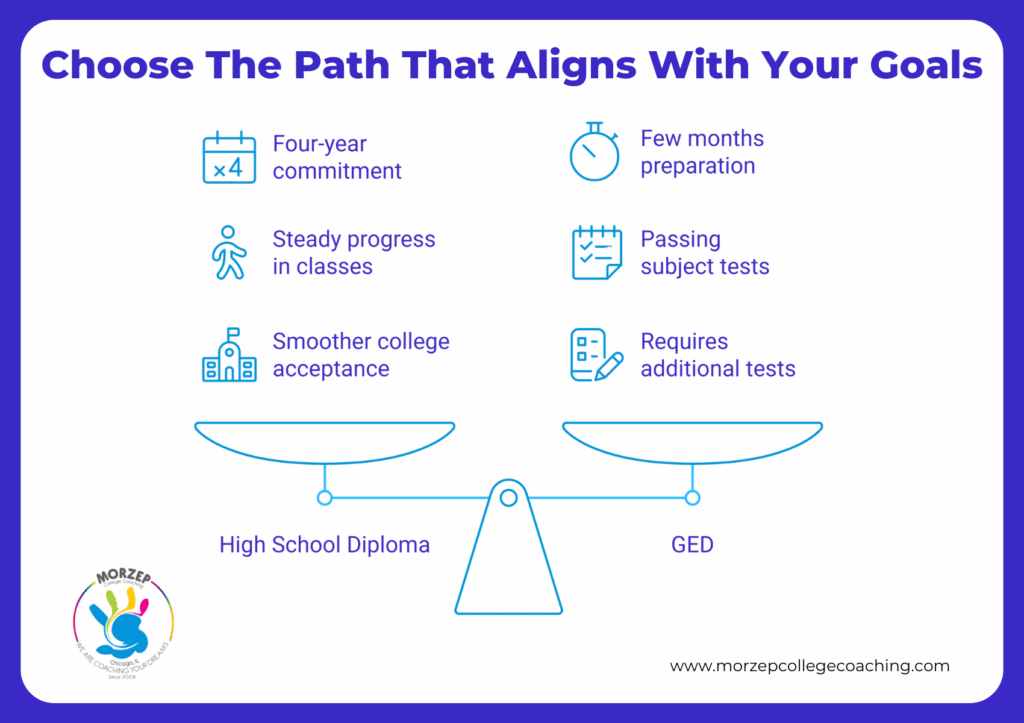
With a lot of studying, some training programs, and an online exam, you can pass your equivalent of high school in a few months rather than four years. That’s the key difference between a high school diploma and a GED.
In this guide on GED vs high school diploma, you’ll find important information about:
- Whether the GED is equivalent to a high school diploma
- The academic opportunities that the diploma and a GED result make available in the future
- How GED impacts university admission
- Getting a job with either a high school or a GED diploma
What does GED stand for?
GED stands for General Educational Development test. Passing it shows the same level of knowledge as finishing high school, but instead of a full high school diploma program, you prove your skills through GED subject tests.
High School Diploma or GED? What’s the Difference?
When it comes to education, a high school diploma and a GED often get mentioned in the same breath, but they’re not quite the same thing. Many people weigh the two paths at different points in life, whether they’re thinking about college, career options, or simply finishing what they started. The good news? Both can open doors. You just need to know which doors you want to walk through.
What Is a High School Diploma?
A high school diploma is awarded after completing the required courses in a traditional or online high school program. Unlike earning a GED, which is based on passing subject tests, a high school diploma is earned through steady progress in classes over several years.
Whether you attend a local school or choose a high school diploma online, this credential shows you’ve completed all the steps of a full high school program.
Many people see a diploma as more than just a piece of paper; it’s a sign of commitment and consistency that can make getting accepted into colleges or training programs a little smoother.
Speak with a college coach today!
Speak with an expert college coach and learn if working with one is right for your academic journey. Free 15-minute consultation, no cost, no obligations.
What Is a GED?
A GED is a test and credentials. This education program includes four subject tests focusing on math, language arts, science, and social studies. If you pass every testing session, your knowledge base is equivalent to a 12th-grade level or a high school graduate.
This GED certificate is a replacement if you haven’t received a traditional diploma from an American school or an online high school.
Taking the ACT or SAT with your GED will significantly boost your ability to get into a good college and build the career you’ve been dreaming of after you finish high school. The GED testing program includes four exams requiring less than 8 hours of your time. Getting a high school diploma and following the traditional route to graduation takes four years, whereas a GED takes just a few months of prep and testing.
You can take the GED as a replacement for a high school diploma. It has been designed as a helpful tool for students who had to drop out of high school for some reason and didn’t get to take those four years the “normal” way.
Usually, people who aren’t enrolled in high school are the only ones who can apply for GEDs.
Do you have a GED if you graduate high school?
No, you don’t automatically have both. If you graduate, you get your high school diploma. A GED is only for people who didn’t complete a traditional or online high school diploma program.
How Does a GED Differ from a High School Diploma?
Since a high school diploma is the most popular route to get your education and provide evidence of general educational development success, it is often seen as a better option. However, that isn’t necessarily the case. When you earn a high school diploma that isn’t outstanding or you don’t graduate from the best school, you’ll still face admission difficulties later on.
About 98 percent of all American colleges, community colleges, and universities will accept GEDs in place of high school diplomas, especially when paired with a good SAT or ACT score. However, it’s not just higher education you have to think about with a GED. This is one of the most important official documents to have if you want to get a good job.
So do employers accept GED as a high school diploma or equivalent? The answer is yes. Most, if not all, jobs that require a high school diploma will accept a GED as a replacement.
How Do You Get a GED?
First, there are a few requirements you need to fulfill before enrolling to take your GED tests.
- You must not be currently attending high school
- You must have never graduated from high school
- You must be at least 18 years old, though some states will allow you to get a GED earlier if you qualify for an age waiver and have parental consent
- Certain states have additional requirements, such as being a state resident or being out of school for a specific time
Most people recommend studying right away. You have to have the same knowledge as average high school seniors, so it can be challenging for someone who hasn’t attended college in quite some time.
You don’t have to take all four tests at once, although you can do that if you wish. However, you can study one subject at a time and take each one at your own pace.
The last step is finding GED testing services. Try and locate the nearest GED testing center and schedule your exam when ready. You can opt for online testing or have your exam in a test center, depending on what suits your needs best.
Which is better: GED or high school diploma?
When it comes to high school diploma vs GED, many people wonder which opens more doors. A school diploma or a GED can both lead to college or jobs, but a diploma may make it easier to get into programs, earn a higher salary, or avoid extra steps like GED prep.
How Do I Prepare for the GED Placement Test?
Preparing for the test can be intimidating, especially if you haven’t been in school for several years. Since you can move at your own pace, you don’t have to be stressed by approaching deadlines or trying to fit in studying around your schedule.
To prepare for the GED, you first want to figure out which test you must pass. Then, you will want to study that subject. The GED is not a test that relies solely on memorization, so you want to ensure you fully understand the subject.
Plenty of practice tests are online to help you prepare before the big day. A passing score is at least 145, though getting above that is better. Online tests will give you a color at the end of your test to tell you how prepared you are for the test. The GED Ready test has been designed to be half the length of a regular GED exam so that you can be confident on your testing day.
Once you feel ready, schedule your test. Taking the test requires paying a fee. Generally, each subject is around 38 dollars.
What is the downside of getting a GED?
One downside of getting a GED is that some employers, colleges, or military programs may view GED recipients less favorably than people who have a traditional high school diploma.
GED vs High School Diploma: A Brighter Academic Future with Morzep
If you are struggling to study or don’t know where to begin, check out online GED courses or talk to one of Morzep’s college coaches. They can guide your steps toward a successful result and help you prepare for your next big step: getting into college.
Our college coaches can help you with your entrance exam, figure out school classes, and guide you on your path to success, from the first step of getting an undergraduate degree to being a fulfilled college graduate.
Fill out our contact form today to get personalized guidance, answers to your questions, and a clear next step toward your goals, whether you intend to complete high school the traditional way or you want to get your GED. Get in touch!