


When students start searching for the top medical schools in the U.S., it usually begins the same way: a few ranking lists, a lot of pressure, and the feeling that you need to aim for the single most impressive name you can find. But picking a medical school is not just about prestige. It is about finding the right fit for your goals, your learning style, and the kind of physician you want to become.
In this guide, we’ll walk through how to think beyond the hype and build a smarter list of top medical schools.
Here’s what we’ll cover:
- What “top medical schools” really means
- What the big-name schools offer, and what rankings miss
- How to compare schools based on research, primary care, and career goals
- What MCAT, GPA, and admission data actually tell you
If you’re serious about a future in medicine, this will help you approach the process with more clarity and a lot more strategy.
Speak with a college coach today!
Speak with an expert college coach and learn if working with one is right for your academic journey. Free 15-minute consultation, no cost, no obligations.
What Do “Best Medical Schools in the US” Actually Mean?
Let’s start here, because this is where a lot of students get stuck.
When people talk about the top medical schools in the U.S., they are usually mixing a few different ideas. Sometimes they mean schools with the strongest reputation. Sometimes they mean the highest-ranked schools in a world report or subject rankings list. Sometimes they mean schools with the best research labs, the most famous faculty, or the biggest name recognition.
Those things can matter. But they are not the whole story.
AAMC advises students to choose schools based on fit, mission, and school-specific admissions data, not just prestige or broad reputation. Its guidance on choosing where to apply points students toward the MSAR tool so they can compare schools by factors like mission, median metrics, and program details.
So what can “best medical school” actually mean?
- A school with strong medical research and major NIH-style funding opportunities
- A school known for primary care and community-based training
- A school with a supportive curriculum and strong advising
- A school that fits your career goals, from academic medicine to public health
- A school where you can realistically thrive, both academically and financially
That last point matters more than students sometimes realize.
A highly ranked university might look amazing on paper. But if the learning environment feels too competitive, the location is a poor fit, or the program does not align with your interests, it may not be the best place for you.
On the flip side, a slightly less famous school of medicine might offer stronger mentorship, better hospital access, or more meaningful opportunities in the exact area you care about.
That is why your goal should not just be finding the “highest” school. It should be finding the right one.
The takeaway here is simple: “top” should mean more than reputation. It should mean alignment. The smartest medical school strategy starts with that shift in mindset.
What is the difference between Tier 1 and Tier 3 medical schools?
A Tier 1 med school may offer stronger NIH research and residency connections, while Tier 3 schools can still provide a rigorous path to an M.D.
The Top 10 Medical Schools in the U.S. and What Students Usually Miss
Now let’s talk about the schools everyone wants to know about.
Yes, there are certain names that show up again and again in conversations about the top 10 medical schools in the U.S. According to Times Higher Education’s 2026 U.S. medicine list, the top 10 are:
- #1 Harvard University
- #2 Johns Hopkins University
- #2 Stanford University
- #4 Yale University
- #5 University of California, Berkeley
- #6 University of Pennsylvania
- #7 University of California, Los Angeles
- #8 Columbia University
- #9 University of Michigan–Ann Arbor
- #10 University of Washington
THE says these rankings are based on factors like teaching, research environment, research quality, industry collaboration, and international outlook. That helps explain why these schools get so much attention.
They tend to offer:
- Extensive research infrastructure
- Highly visible faculty members
- Strong hospital affiliates
- National and global reputation
- Access to advanced labs and cutting-edge clinical opportunities
If you are drawn to academic medicine, competitive specialties, or a research-heavy path, those are real advantages.
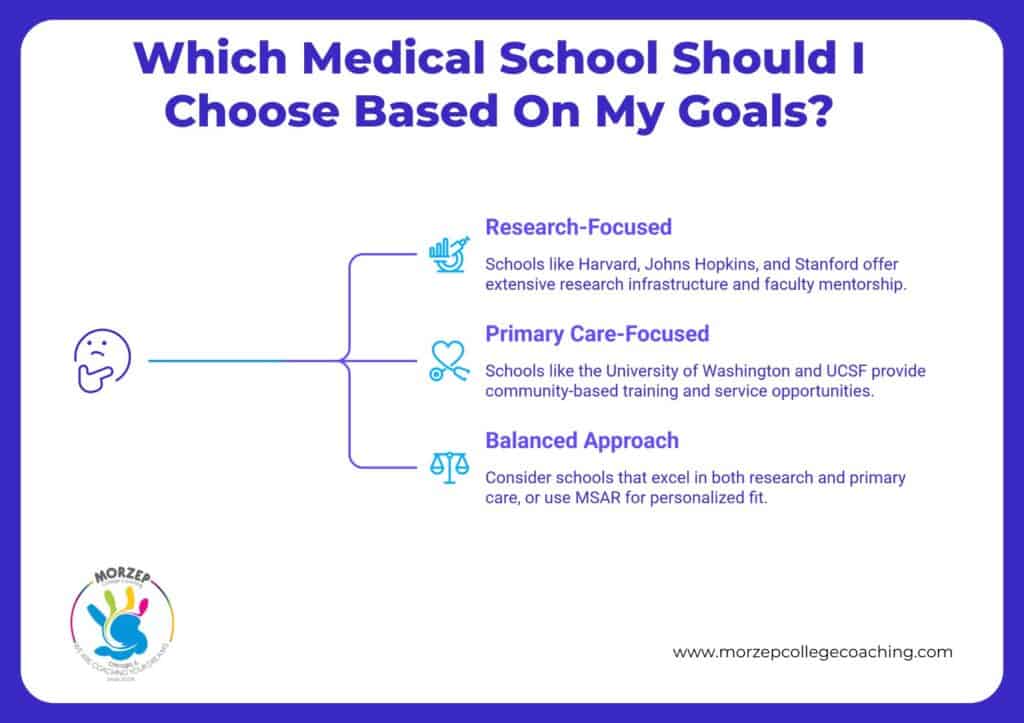
Best Medical Schools in the US for Research
If research is a big part of your future goals, rankings like THE can be a helpful starting point because they reward schools with strong research environments and high research quality. That is one reason names like Harvard, Johns Hopkins, Stanford, Penn, UCLA, and Columbia show up so often near the top. These schools tend to have:
- Large academic medical centers
- Strong lab and faculty mentorship opportunities
- Access to major hospital systems
- High visibility in biomedical and clinical research
That said, if you are looking specifically at research-focused medical school rankings, it helps to know that different ranking systems do not always measure the same thing. U.S. News changed its medical school rankings approach in 2024 and now groups schools into tiers rather than publishing a simple, numbered, top-to-bottom list for research and primary care.
Highest Ranked Schools in the US for Primary Care
This is where students sometimes need a different lens.
A school that is excellent for research is not automatically the best choice for a student who wants to pursue primary care, community medicine, or public health. In U.S. News’ 2024 primary care grouping, schools in the top tier included programs such as the University of Washington, University of California–San Francisco, University of Minnesota, and University of North Carolina at Chapel Hill.
That matters because students interested in primary care may want to look more closely at things like:
- Community-based clinical training
- Service to underserved populations
- Rural or urban health pathways
- Public health and advocacy opportunities
- Early patient-facing experience
So if your goals lean more toward family medicine, internal medicine, pediatrics, or community health, a primary-care-focused ranking may tell you more than a prestige-heavy research list.
Other Medical Schools in the US Rankings
Students often assume there is one “official” list of the best medical schools. There really isn’t.
Different rankings look at different things. For example:
- Times Higher Education leans heavily into teaching, research environment, research quality, industry, and international outlook.
- U.S. News now uses tiered groupings for research and primary care rather than a strict numbered list, after changing its methodology.
- AAMC takes a different approach and encourages students to build their own school list based on fit, mission, and data through MSAR rather than relying on national rankings alone.
That difference is worth paying attention to. A school can look incredible in one ranking system and less impressive in another, simply because the methodology is different.
If you are reading a list of top-ranked medical schools, treat it like a starting point. It can help you see which institutions have a broad reputation and strong research visibility. But it should not be the only lens you use.
A much smarter question is: Which schools fit the kind of doctor I want to become?
That is the shift that turns a ranking search into a smart school search.
What strategies can I use to get into a top medical school?
Start early in your undergraduate years with strong grades, meaningful community service, solid recommendation letters, and a thoughtful personal statement.
MCAT, GPA, Acceptance Rates, and Medical School Requirements: What the Numbers Really Tell You
Let’s talk about the numbers, because they matter. But they only help when you read them in context.
According to AAMC’s 2025 data, the mean MCAT for all applicants was 506.3, while the mean MCAT for matriculants was 512.1. The mean GPA was 3.67 for applicants and 3.81 for matriculants.
Those figures are useful because they give you a realistic picture of the national admissions landscape.
They also tell you something important: strong numbers matter, but they are not the only story.
Here’s what those numbers can help you do:
- Understand the level of academic competition
- Build a more balanced school list
- Compare your profile with school-specific ranges
- Avoid applying blindly based on brand name alone
And here’s what they cannot do on their own:
- Tell you whether a school is the right fit
- Predict your full admissions outcome
- Replace the importance of your experiences, writing, and overall application story
That matters because medical school applications are not evaluated on MCAT and GPA alone. Schools also care about your clinical exposure, service work, leadership, writing, and the consistency of your interest in the medical field.
So how should you use your stats?
Think in terms of strategy, not ego.
- Reach schools are fine
- Match schools are essential
- Mission-fit schools are often where smart applicants gain traction
- A balanced list is stronger than a prestige-only list
If your MCAT score is solid but not spectacular, that does not mean you are out of the running for a meaningful path in medicine. It means you need to be thoughtful. That is a much better place to start than panic.
The takeaway from this section is simple: use the numbers to guide your plan, not to define your worth.
Is a 3.7 GPA good enough for medical school?
Yes, a 3.7 GPA can be competitive for medical school, especially with a strong MCAT and clear experience in the field. Some medical universities may expect more, but it is still a solid foundation for future medical students.
Questions to Ask Before You Apply to Any Medical School
This section is where things get practical.
If you are building a school list, here are the questions that actually help. These are the kinds of questions that move you past vague ideas like “good school” or “top university” and into more thoughtful decisions.
Does this medical school’s mission match the kind of physician I want to become?
AAMC explicitly encourages students to evaluate a school’s mission and ask whether it aligns with their values and goals.
That means you should look for clues like:
- Does the school emphasize research?
- Does it prioritize primary care?
- Does it focus on underserved communities, public health, or advocacy?
- Does that feel aligned with what you care about?
Will this curriculum work for how I learn best?
Not every student thrives in the same format.
Ask:
- Is the curriculum systems-based?
- Is it pass/fail?
- How early do students get patient exposure?
- Does the classroom style feel supportive or overly rigid?
What kind of clinical training will I actually get?
This one matters a lot.
Look into:
- Hospital affiliates
- Community settings
- Rotation locations
- Exposure to diverse patient populations
- Specialty access if you are already leaning toward a field
Can I realistically afford this program?
Students sometimes leave this question for too late.
But debt, financial aid, and cost of living are a huge part of medical school reality. That makes scholarship and aid planning worth considering early, not just once offers arrive.
AAMC points students toward school-specific admissions and planning resources, and this is one of the strongest reasons why.
The point of these questions is not to make the process more complicated. It is to make your choices more grounded.

Thinking About Medicine? Let’s Build Your College Plan Together
If you think medicine might be part of your future, we want you to know something right away: you do not need to have every step figured out today.
What you do need is a smart plan, steady support, and the right guidance at the right time.
At Morzep College Coaching, that is exactly what we offer. We work with students over time, helping them discover their options, build on their strengths, and present the best version of themselves throughout the college admissions process.
For students who may be considering a future in healthcare, premed, or eventually medical school, that kind of support can make a real difference.
We do not believe in one-size-fits-all coaching. We believe your plan should reflect who you are, where you want to go, and what kind of support will actually help you get there.
Here’s what that can look like when we work together:
- Building a college list that matches your goals and strengths
- Strengthening your academic profile over time
- Helping you shape extracurricular activities into a more compelling story
- Supporting your essays with detailed feedback and editing
- Preparing you for interviews
- Guiding you through financial aid planning and required documents
- Helping you stay organized through each stage of the admissions process
Whether you are just beginning to think about college, narrowing down your goals in high school, or getting ready for applications, we can help you create a path that feels ambitious, realistic, and personal to you.
That is the heart of what we do at Morzep: helping you move forward with more clarity, more confidence, and a plan that actually fits your future. Get in touch today!