


If you’ve started researching medical school requirements, you’ve probably already noticed something frustrating: every site seems to give you a slightly different answer. And honestly, that’s because there isn’t one universal list of medical school admission requirements that works for every applicant or every school of medicine.
In this guide, we’re breaking down what you really need to know before you apply to medical school, from prerequisite courses and MCAT timing to technical standards, AP credit, GPA, and the details students often miss.
Here’s what we’ll cover:
- The real course requirements
- What schools expect beyond grades
- How the medical school application process works
- Common mistakes applicants make
If you want a clearer path forward, keep reading.
Speak with a college coach today!
Speak with an expert college coach and learn if working with one is right for your academic journey. Free 15-minute consultation, no cost, no obligations.
Medical School Admission Requirements Are Not as Standardized as People Think
Let’s start with the biggest misconception.
A lot of students assume there’s one official national list of medical application requirements. There isn’t. The AAMC explains that medical schools may differ in their required and recommended coursework, and the Medical School Admission Requirements resource is updated annually precisely because these details vary by school.
So yes, there are patterns. Most U.S. schools expect a bachelor’s degree before matriculation, strong science preparation, and a competitive academic record. But that does not mean every medical college evaluates premedical coursework requirements the same way. One school may want biochemistry as a firm requirement. Another may list it as recommended. One may accept AP credit. Another may not.
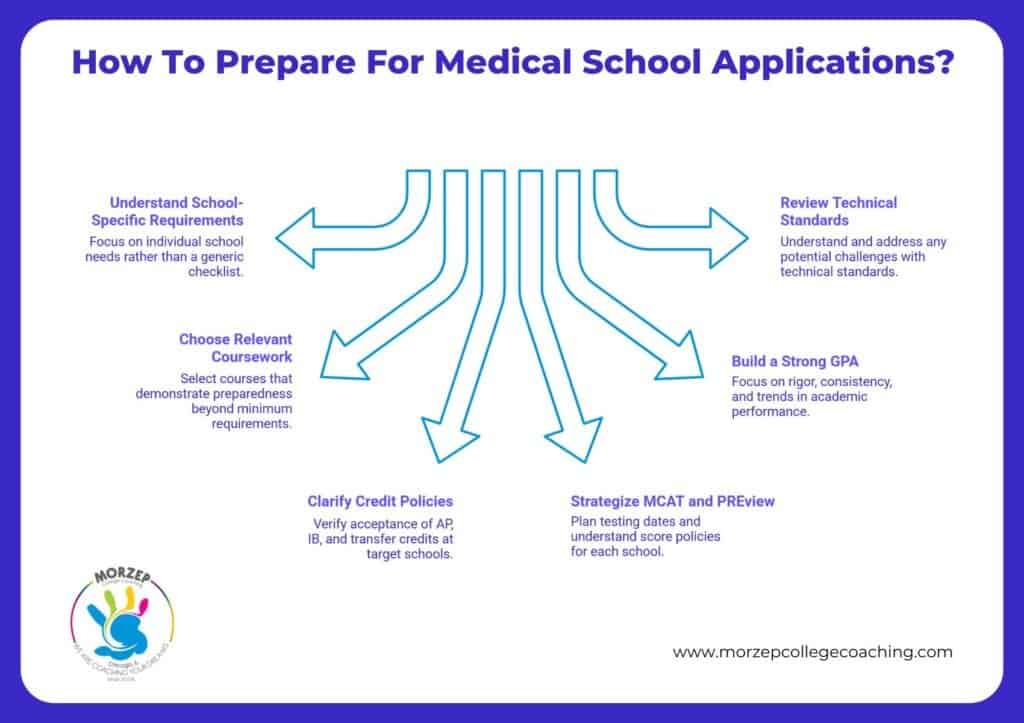
That’s why one of the smartest things any applicant can do is stop thinking in terms of one generic premed checklist and start thinking in terms of school-specific fit.
Here’s the practical takeaway:
- A four-year degree is generally expected before entering medical school.
- Schools may differ on prerequisites, AP policy, and accepted coursework sources.
- The AAMC’s MSAR tools exist because this information is not perfectly standardized.
That can sound overwhelming at first, but it’s actually useful. Once you understand that the rules vary, you stop relying on broad internet advice and start building a plan that actually matches the schools you may want to apply to.

What Coursework Do You Really Need for Medical School?
Now let’s get into the part most students worry about first: classes.
In general, many schools still expect a familiar premed foundation. The AAMC says many medical schools commonly require one year of biology, one year of English, and two years of chemistry that includeorganic chemistry. But that is a starting point, not a universal script.
Depending on the school, you may also see expectations around:
- Physics
- Math or statistics
- Social science
- Upper-level biology
- Humanities and social sciences preparation
And increasingly, biochemistry requirements matter. For example, UC Irvine’s School of Medicine lists chemistry preparation that includes general or inorganic chemistry, organic chemistry, and biochemistry.
This is why it helps to think beyond “Did I take the required classes?” A stronger question is: “Does my coursework show I’m genuinely prepared for medical school?”
That might mean adding classes like:
- Molecular biology
- Physiology
- Genetics
- Cell biology
- Advanced lab work
Those courses are not always formally required, but they can make your academic preparation look a lot more convincing to an admissions committee, especially if your school list includes research-heavy or academically intense programs.
So yes, check the courses that are required. But do not stop there. Your transcript should tell a story. It should show that you didn’t just scrape together the minimum premedical coursework. It should show real preparation for the pace, depth, and science-heavy environment of a medical curriculum.
Are letters of recommendation required for medical school?
Yes, in most cases, letters of recommendation are part of the requirements for admission. Each admission requirements website will explain how many letters are needed.
AP or IB Credit, and Transfer Courses Can Get Tricky Fast
This is one of the most overlooked parts of the process, and it causes more confusion than students expect.
Let’s say you used AP Biology, AP Chemistry, or another advanced placement course to skip an intro class at your college or university. That might have worked perfectly for your undergraduate plan. But it does not automatically mean those credits will satisfy every school’s requirements when it is time to apply.
The AAMC specifically notes that schools vary in whether they accept AP credit, online coursework, and community college work. That is exactly why students need to read the fine print.
UC Irvine gives a good example of how specific this can get. The school accepts AP scores of 4 or 5 in certain areas, including some chemistry, physics, calculus, statistics, and humanities categories, but says International Baccalaureate credit is not accepted for prerequisite purposes.
That means the real question is not, “Does AP count?” The real question is, “Does this particular school accept my AP or IB setup in this particular subject?”
A smart way to think about it:
- Check whether AP appears on your official transcript
- Confirm whether the school accepts AP or IB credit
- If you skipped intro science, consider adding upper-level science courses anyway
- Verify whether lab courses must be completed in person
This matters even more if you are a transfer student or if some of your courses came from more than one institution. In that situation, schools may look closely at where prerequisites were completed and whether they came from a regionally accredited or otherwise accredited college.
MCAT Score and the AAMC PREview Exam
Yes, the MCAT still matters. A lot.
The Medical College Admission Test remains a central part of the medical school application process, and the AAMC’s AMCAS applicant guide still points students to the MCAT as a core part of applying. But what often gets missed is that schools do not all use the test in the same way.
Some schools set specific score windows. Some publish screening thresholds. Some focus more on the balance between GPA and test performance. Wake Forest, for example, says applicants for 2026 admission may use MCAT scores dating back to January 2022, and that a minimum MCAT score of 500 is required to be reviewed.
That is a great example of why timing matters just as much as the number itself. A student can take the exam, earn a respectable score, and still run into problems if the date range does not match the school’s policy.
Then there’s the AAMC PREview professional readiness exam. This is not a universal requirement, but it is becoming more relevant. The AAMC says the PREview exam is offered from April through October 2026, registration is open for the 2026 testing year, and a growing number of U.S. schools are participating in its use during admissions.
So what should you actually do with all this?
- Build your testing plan around your intended application year.
- Check the score age policies at each target school.
- Do not assume PREview is required everywhere.
- Do not treat the MCAT like a last-minute checkbox.
This section really comes down to strategy. A strong MCAT can help. A rushed or poorly timed plan can limit your options. The goal is not just to take the test. It is to take it in a way that supports the schools you want.
What undergraduate degree or major is best for medical school?
There isn’t one “best” major for every future medical student. You can major in almost anything as long as your courses cover the chemistry requirements, biology courses, and other classes needed for the practice of medicine.
GPA and Academic Requirements: What Admissions Committees Actually Notice
Students hear “keep your GPA up” all the time. The problem is that the advice is too vague to be useful.
When schools talk about academic requirements, they are usually looking at a bigger picture than one number. Yes, your overall GPA and cumulative undergraduate GPA matter. So does your science performance. But admissions readers also notice rigor, consistency, and trends over time.
Wake Forest offers one concrete example. Its published review threshold includes a minimum 3.2 science or BCPM GPA and at least 15 BCPM credit hours to receive a secondary application. That does not mean every school uses that exact formula. It does show, though, that schools can be more specific than students realize.
This is where many applicants misunderstand what makes them look academically credible.
It is not just:
- A decent GPA
- A solid MCAT score
- The bare minimum prerequisite courses completed
It is also:
- The strength of your science courses
- Whether you challenged yourself
- Whether you recovered from setbacks
- Whether your transcript suggests real readiness for medical school
And this is where recommended courses can matter more than they seem to. A school may not list physiology, statistics, or biochemistry as mandatory, but if many successful applicants have those courses, they can function like unofficial expectations.
That is especially important for students planning their preparation for medical school at an accredited college or university. You want your record to show more than eligibility. You want it to show momentum.
So the conclusion here is simple: admissions committees are not only asking, “Did this student meet the requirement?” They’re also asking, “Does this student look ready to thrive once classes actually begin?”
Technical Standards and Other Additional Medical Application Requirements Students Miss
Here’s a detail many applicants do not look at until they are already deep in the process: technical standards.
These are the physical, cognitive, communication, and behavioral abilities a medical school expects students to meet, with or without reasonable accommodation. Schools may include them right alongside their published application requirements because they are part of what students must be able to handle throughout medical training.
In plain language, technical standards often relate to:
- Observation
- Communication
- Motor and sensory function
- Intellectual and quantitative ability
- Behavioral and professional conduct
For some students, this may not affect planning much. For others, especially students who anticipate needing accommodations or who have questions about how schools interpret these standards, it is worth reviewing early.
So the takeaway here is pretty practical. Read beyond the headline requirements. The students who do that early tend to avoid a lot of confusion later.
What extracurricular activities are important for medical school admissions?
The strongest activities usually show real interest in the practice of medicine and service to others. Clinical experience, volunteering, shadowing, research, and leadership can all help.
Where We Come In: Making the Medical School Process Less Confusing
If all of this feels like a lot, that’s because it is.
The truth is, medical school admissions can get complicated fast. There are academic requirements, testing timelines, transcript details, school-specific policies, essays, interviews, and plenty of small decisions that can have a big impact on your application. That’s where we come in.
At Morzep College Coaching, we work closely with students to make this process feel more manageable, more strategic, and a lot less overwhelming. Our approach is personal, hands-on, and built around the reality that no two applicants are exactly alike.
We help students look at the full picture. That means more than checking whether you’ve completed the right coursework or earned a competitive MCAT score. We help you understand how your academic record, extracurricular experiences, school list, timeline, college essays, and overall story fit together in the real medical school application process.
If you’re ready to stop guessing and start planning your path to medical school more strategically, reach out to Morzep College Coaching. We’d love to help you build a clearer, stronger plan for the road ahead.