


Somewhere between the first Common App login and the last decision letter, most families hit a point where they just want someone to tell them what’s next. That’s normal. A survey by the National Association for College Admission Counseling found that 77% of applicants described the process as complex, and more than half said it was more stressful than anything else they’d done academically.
Here’s the thing, though: none of this is actually as complicated as it feels in the moment. It just has a lot of small moving parts, spread out over three years, with different deadlines depending on the school and the plan you choose. Once you can see the whole shape of it, most of the stress goes away on its own.
That’s what this guide is for. Whether your student is a sophomore just starting to think about college or a senior staring down a January deadline, here’s what’s inside:
A month-by-month college application process timeline, from 10th grade through decision day
A plain-English breakdown of Early Action, Early Decision, Regular Decision, and Rolling Admissions
A college application process checklist covering every document schools actually ask for
How extracurriculars really factor into admissions decisions
What to do after you submit, including fixing mistakes and handling a waitlist
How to actually compare financial aid award letters once they arrive
Practical guidance for first-generation applicants
Speak with a college coach today!
Speak with an expert college coach and learn if working with one is right for your academic journey. Free 15-minute consultation, no cost, no obligations.
How to Apply to College: An Overview
Every application, no matter the school, involves the same basic players: the student, the parents, a high school counselor, and sometimes a college coach. Most students submit through a centralized platform, the two biggest being the Common App and the Coalition Application, though some schools (MIT and the University of California system, for example) run their own separate systems.
A complete application usually includes a transcript, test scores (if the school requires them), a college essay, letters of recommendation, an activity list, and an application fee or fee waiver. We’ll walk through each one below.
College vs University: Does the Difference Actually Matter?
A quick aside, since this issue trips up many families as they build their college lists. In the U.S., the terms are used interchangeably, but there’s a technical difference. A university usually offers both undergraduate and graduate degrees and leans heavily into research. A college is typically smaller and focused on undergraduate teaching. It may operate independently or as part of a larger university. Neither label tells you much about quality or fit, so don’t let the name on the building drive your list. What matters is the program, the campus culture, and whether it’s a genuine academic match.
What is the Common App and how do I use it?
It’s a single online application accepted by over 1,000 colleges. You create one account, fill in your basic info and main essay once, then send it to each school on your list along with any school-specific supplements they ask for.
Month-by-Month College Application Process Timeline
Here’s where a lot of guides fall short: they treat the process as a senior-year sprint. It’s really a three-year build.
Sophomore Year: Laying the Foundation
Focus on your grades. High school GPA matters more than most students realize, and it’s the one thing colleges weigh across all four years.
Get involved in one or two activities you actually care about. Depth beats a long list.
Start exploring, no pressure yet. Just get a feel for what kind of school might fit you.
Junior Year, Fall to Spring
September to December: Take the PSAT, meet with your counselor to plan junior-year coursework, and start noticing which subjects genuinely interest you.
January to March: Begin building a balanced college list: a few reaches, several targets, at least one or two safeties. Start SAT or ACT prep if you’re taking a standardized test.
April to May: Visit campuses if you can. Ask your counselor which teachers might write strong letters of recommendation next fall.
Summer before senior year: Draft your personal statement while you have time to breathe. Our junior year checklist breaks this whole stretch down in more detail.
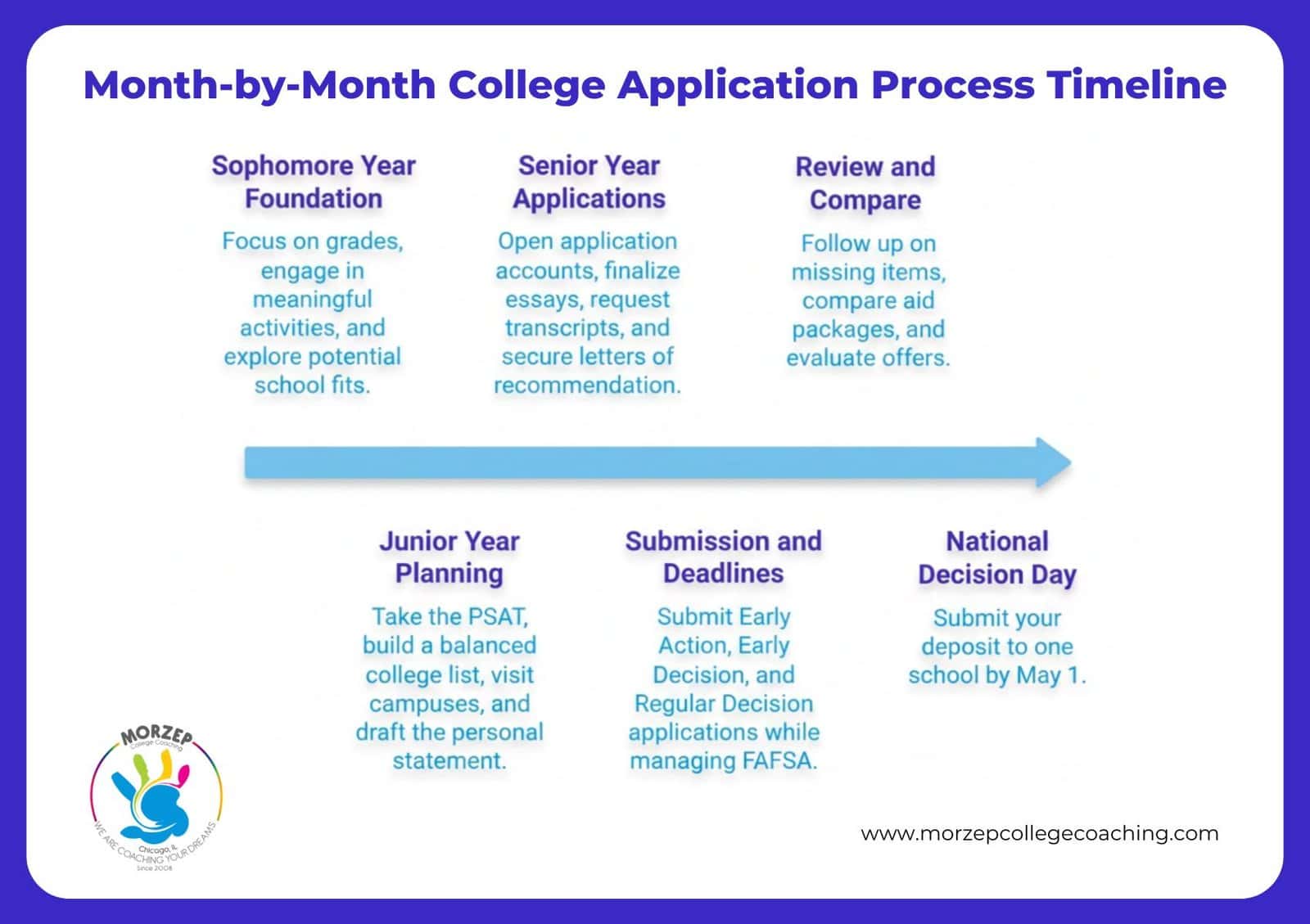
Senior Year, Fall to Spring
August: Applications open on most platforms. Create your accounts and start entering the basics.
September to October: Finalize essays, request transcripts, and formally ask for letters of recommendation. Teachers get busy fast once fall hits.
November: Early Action and Early Decision deadlines. Submit and breathe.
December to January: Regular Decision deadlines, plus your FAFSA priority window opens. Don’t let one distract you from the other.
February to March: Wait, follow up if something’s missing, and start comparing costs as aid packages trickle in.
April: Most decisions are out. Compare offers side by side.
May 1: National Decision Day. Submit your deposit to one school.
What are the steps in applying for college?
Broadly: research schools, gather your materials, write your essays, submit through the Common App or a school’s own portal, then track deadlines and follow up. Most students start building their list in junior year and submit applications between August and January of senior year.
Understanding Application Deadlines
Early Action (EA): Non-binding. Apply in the fall, hear back early, no obligation to attend.
Early Decision (ED): Binding. If you’re accepted, you commit and withdraw other applications.
Regular Decision: The standard timeline, usually January deadlines with spring decisions.
Rolling Admissions: Schools review applications as they come in rather than by a single deadline.
Your College Application Process Checklist
High school transcript
Test scores, if required (roughly 80% of four-year colleges are now test-optional, so check each school’s policy before assuming you need them)
Personal essay or personal statement, typically 500 to 650 words. Our essay prompt breakdown covers the most common ones and how to approach them.
Letters of recommendation, usually one or two teachers plus a counselor
Activity list or resume
Application fee, or a fee waiver if cost is a barrier
How Extracurricular Activities and Community Service Factor Into Admissions
Here’s some reassurance: extracurriculars matter, but probably less than students assume. According to NACAC’s State of College Admission data, only about 6.5% of colleges call activities “considerably important,” though another 44% rate them “moderately important.” Grades and course rigor still carry the most weight.
That doesn’t mean skip the club fair. It means:
Depth over breadth. Sticking with one or two activities for years says more than a resume padded with twelve one-semester clubs.
Leadership matters more than titles. Starting something small and running it well often reads better than an inherited officer position.
Community service should be genuine, not performative. Admissions officers read many essays and can usually tell the difference.
What are red flags in college applications?
Inconsistent information between the application and transcript, unexplained grade drops, generic essays that could apply to any school, and missing required materials are the most common issues admissions officers flag.
Paying for It: FAFSA, CSS Profile, and Comparing Award Letters
Financial aid runs on its own clock, and it’s easy to let it slip while you’re focused on essays. Here’s the thing: only about 56% of high school seniors complete the FAFSA, leaving billions in Pell Grant money unclaimed every year. Don’t be part of that statistic.
Our FAFSA breakdown explains what the form actually asks for, and if your target schools require it, the CSS Profile has its own separate deadlines worth tracking early. For a wider look at grants, loans, and scholarships, our financial aid options guide is worth bookmarking too.
How to Compare Financial Aid Award Letters
Every school formats these differently, which makes comparing them genuinely confusing. A few things to check on each one:
Separate free money from money you’ll owe back. Grants and scholarships don’t get repaid. Loans must be repaid, while work-study requires students to earn the awarded funds through employment.
Calculate the real net cost, not just the headline scholarship number. Subtract all grants and scholarships from the total cost of attendance.
Check if awards renew. A generous freshman-year scholarship that isn’t guaranteed for years two through four changes the real cost significantly.
Call the financial aid office if anything’s unclear. They expect these questions, and they’d rather clarify now than after you’ve committed.
What to Do After You Hit Submit
Submitting isn’t the finish line.
Fixing Mistakes and Missing Materials
If you notice an error after submitting, such as an incorrect test date or a missing transcript, don’t panic. Most schools let you email the admissions office directly to correct it or send an addendum. Silence is worse than a follow-up email. Admissions offices deal with this constantly.
Demonstrating Continued Interest
Some schools track how engaged you are after you apply. That doesn’t mean bombarding them with emails. It means opening the emails they send, attending a virtual info session if one’s offered, and responding promptly if they reach out for an interview or additional information.
If You’re Waitlisted
Nationally, about 20% of students who stay on a waitlist are eventually admitted. A well-written letter of continued interest can help your odds, but so does securing your spot at another school by May 1 in the meantime. Don’t leave yourself with nothing while you wait.
How long does the college admission process take?
From building your first college list to a final decision, most families are looking at a year to a year and a half, spanning junior year through the spring of senior year.
Application Strategies for First-Generation College Students
If you’re the first in your family to go through this, you’re in good company. Roughly 38% of undergraduates nationwide are first-generation students, per NCES data. There’s no family playbook to follow here, and that’s completely normal.
A few things that genuinely help:
Lean on your school counselor early, and ask directly about TRIO or similar first-gen support programs if your school has them.
Always ask about fee waivers. Application fees, test fees, and even CSS Profile fees can often be waived, but usually only if you ask.
There’s no dumb question. If you don’t know what a transcript request even involves, ask. Every admissions office has fielded that question before.
Find one person in your corner who can walk through decisions with you, whether that’s a counselor, a teacher, or a coach, who can walk through decisions with you when there’s no one at home who’s done this before.
How many colleges should I apply to?
Most students do well with 6 to 8: one or two reaches, a few solid targets, and one or two safeties. Going much higher than that usually just spreads your essay time and application fees thin without improving your odds.
Taking Care of Yourself During the Process
It’s worth saying plainly: this process is genuinely stressful for most families, not just yours. A few things that help most students get through it in one piece:
Build in actual breaks. A weekend without essay drafts won’t derail your timeline.
Keep some perspective. One deadline, one school, one decision doesn’t define your worth or your future.
Talk to someone, such as a counselor, parent, or friend, when it feels like too much.
Try not to compare your timeline to everyone else’s. Different students move at different speeds, and that’s fine.
Ready to Build Your Application Strategy?
The college application process is a lot to carry alone, and you don’t have to. At Morzep, we work one-on-one with students and families to build a personalized plan rather than rely on a generic checklist. Our support covers everything from your college list to your final essay draft. Schedule a consultation with our team to see how we can help.
If your student is currently in 11th grade, junior year is the best time to start. Learn more about our coaching for 11th graders and get ahead of senior year before the rush hits.