


Your GPA is solid. Your MCAT score is competitive. Your clinical hours are logged. And now you’re staring at a blank document knowing that this one piece of writing (your medical school personal statement) could be the thing that gets you in or keeps you out.
No pressure, right?
The good news: writing a strong personal statement is a learnable skill. In this guide, we’ll break down real medical school personal statement examples, show you exactly what the medical school admissions committee is actually looking for, and walk you through how to write yours from scratch.
Here’s what we’ll cover:
Ready to write something that actually sounds like you? Let’s get into it.
Need help with your medical school application?
At Morzep College Coaching, our coaches have 60+ years of combined experience helping students write personal statements that get accepted. Schedule a free consultation today.

Photo by Yan Krukau on Pexels
What Is a Medical School Personal Statement?
Your personal statement is the narrative portion of your med school application. It’s a 5,300-character essay (roughly 650–850 words) where you explain why you want to become a doctor, what experiences led you there, and what kind of physician you’re working toward becoming.
It’s submitted through AMCAS for allopathic (MD) programs and through AACOMAS for osteopathic (DO) programs. Both have the same character limit.
Why It Actually Matters
Every medical school applicant submits a GPA and an MCAT score. According to the AAMC, over 50,000 people apply to medical school in the U.S. each year. Those numbers alone don’t tell a school who you are.
Your personal statement does. It’s often the difference between an interview invitation and a form rejection.
How Medical Schools Use It
Medical schools use the personal statement to answer a few specific questions:
Do you actually understand what medicine involves? Have you been in clinical settings? Have you seen what doctors actually do, not just the idea of it?
Can you reflect on your experiences meaningfully? Not just “I did X” but “X taught me Y, and here’s how that shapes my approach.”
Is your writing clear and mature? You’ll write patient notes, research papers, and clinical documentation for the rest of your career.
Do you have a reason that’s specific to you? The admissions committee has read thousands of personal statements. Generic reasons don’t land.
How long should a medical school personal statement be?
Most medical school personal statements should stay within the application character limit, usually around 5,300 characters for AMCAS. Keep it focused, clear, and meaningful.
What the Admissions Committee Actually Wants
Here’s what we tell every student at Morzep College Coaching: the admissions committee isn’t looking for a perfect person. They’re looking for a self-aware one.
A strong personal statement reflects your real story. Not a polished version of what you think they want. Your actual path, including the moments that surprised you, challenged you, or changed how you see the medical field.
The Four Things Every Strong Statement Does
Tells a story, not a résumé. Your activities section already lists what you did. The personal statement explains what it meant and how it moved you toward medicine.
Answers “why medicine” with specificity. “I want to help people” is not enough. Every teacher, nurse, and social worker wants to help people. What is it about becoming a physician specifically that drives you?
Demonstrates personal growth. Show how you’ve changed, learned, or developed through your pre-med journey. Medical training is relentless. Schools want students who can grow under pressure.
Sounds like a person, not a press release. If your statement reads like a corporate bio, it’s not doing its job. The best personal statements read like you’re talking to someone who genuinely wants to know your story.
Medical School Personal Statement Examples
Let’s look at what strong personal statement writing actually looks like in practice. These are illustrative examples based on real structural patterns from accepted students.
Example 1: The Clinical Turning Point
“I didn’t expect to find my answer in a nursing home in rural Illinois. I was shadowing a family physician on a Tuesday morning when he spent 40 minutes with a patient who had maybe six months left. He didn’t rush her. He sat on the edge of her bed and asked about her daughter in Phoenix. That wasn’t in her chart. He just knew. I watched her face shift from anxious to something close to peaceful. I left that room knowing I wanted to spend my career doing exactly that.”
What works here: It’s specific. We know the location, the day, the details. The writer doesn’t just say, “I shadowed a doctor and loved it.” They show us a moment and let the meaning emerge from it. That’s the difference between a good personal statement and a forgettable one.
Example 2: The Non-Traditional Path
“My first career was in software engineering. I was good at it, and I left anyway. The decision came after my mother’s hospitalization, where I spent three weeks watching a medical team work. I saw how the physicians moved, how they held information in their heads while also holding space for our family’s fear. I came home and enrolled in my first pre-med courses at 31. I am a better applicant for the time I took.”
What works here: The writer doesn’t apologize for a non-traditional timeline. They own it and reframe it as a strength. Medical schools value maturity. If your path to medicine was unconventional, that’s not a liability. It’s a differentiator if you explain it right.
Example 3: The Personal Challenge That Became a Calling
“When I was diagnosed with Type 1 diabetes at 15, I spent the next two years angry at my body. The shift came when an endocrinologist sat down with me and explained not just what was happening, but why. She treated my questions like they mattered. That conversation changed how I saw the relationship between a doctor and a patient, and it eventually changed what I wanted to do with my life.”
What works here: Personal challenges are valid material, but only when they’re handled with reflection, not victimhood. Notice this writer doesn’t dwell on the illness itself. They use it as a lens to explain why they want to become a physician. That’s the right balance.
Can I reuse my medical school personal statement for every school?
Yes, your main personal statement is usually the same for each school. However, your secondary essays should be tailored to each program.
AMCAS Personal Statement Examples and Format
The AMCAS personal statement is the version submitted through the American Medical College Application Service, which sends your application to the allopathic MD programs on your list. Understanding the format is step one before you start writing.
AMCAS Format Rules
Character limit: 5,300 characters including spaces. That’s roughly 650–850 words for most writers.
No formatting: Bold, italics, and special characters don’t transfer. Plain text only.
One prompt: “Use the space provided to explain why you want to go to medical school.” That’s it. Open-ended on purpose.
Shared across schools: Every school on your AMCAS list reads the same statement. It can’t be tailored per school (that’s what secondaries are for).
What Makes a Strong AMCAS Personal Statement
The open-ended prompt is both a gift and a trap. Some applicants freeze trying to write “everything.” The best AMCAS personal statements focus on one or two core experiences woven together by a central theme, not a highlight reel of every meaningful thing you’ve ever done.
Think of it this way: your application already shows what you’ve done. The personal statement is about who you are because of it.
For DO programs, the AACOMAS personal statement uses the same character limit and a similarly open prompt. The main difference is that schools expect you to show genuine understanding of and interest in osteopathic medicine specifically, not just medicine in general.
For Texas schools, the TMDSAS version caps at 5,000 characters with slightly different framing, but the same principles apply.
Pre-Med Personal Statement Examples for Different Backgrounds
One of the most common things we hear from students is: “My story isn’t interesting enough.” That’s almost never true. The issue usually isn’t the story. It’s the framing.
Here’s how different pre-med backgrounds can be framed effectively:
The Research-Heavy Pre-Med
If most of your formative experiences were in a lab, don’t lead with the science. Lead with the moment the science became personal. What question were you trying to answer, and why did it matter to you? What did research teach you about how medicine advances? Then connect it to patient care, because that connection is what makes research pre-meds compelling to admissions committees.
The Community Service Pre-Med
Students with extensive volunteering or service backgrounds sometimes struggle to tie their work to medicine specifically. The key is to show what working closely with underserved communities taught you about healthcare gaps, access, or the relationship between social factors and health outcomes. That’s not just a good essay. It’s exactly the kind of perspective medical schools want on their campuses right now.
The Career-Changer Pre-Med
Former teachers, engineers, or business professionals often have the richest personal stories but the hardest time writing them. Don’t explain or justify the pivot. Show what your first career gave you and how that makes you a better applicant than you would have been at 22.
The “Average Stats” Pre-Med
If your GPA or MCAT isn’t where you hoped, your personal statement carries more weight. It’s not the place to address your numbers, but it is the place to show intellectual depth and genuine motivation. A weak personal statement can make an otherwise competitive application less compelling.
What topics should I avoid in my medical school personal statement?
Avoid repeating your resume, sounding overly dramatic, blaming others, using clichés, or writing about medicine in a vague way.
What to Avoid: Common Mistakes in Med School Personal Statements
We’ve reviewed hundreds of personal statements at Morzep College Coaching. The same problems come up over and over.
The “Childhood Dream” Opening
Starting with “Ever since I was a child, I knew I wanted to be a doctor” is one of the most common openings the admissions committee sees. It signals that you haven’t thought hard enough about your real reason for pursuing a medical career. Even if it’s true, find a more specific entry point into the story.
Packing in Too Many Experiences
A personal statement that lists seven different clinical experiences, three research projects, and two mission trips isn’t a personal statement. It’s a second activities section. Pick one or two experiences that genuinely shaped your path and go deep. Depth beats breadth every time in this format.
Writing for the Reader, Not Yourself
You can usually tell when a personal statement was written to impress. It reads a little too polished. The sentences that get remembered are the ones that reveal something real: a moment of doubt, an unexpected lesson, a realization that surprised even you.
Skipping the “So What”
Every experience needs to answer the implicit question: “So what does this have to do with you becoming a physician?” Describing what happened without reflecting on what it meant misses the whole point. And skip the medical jargon. Your personal statement is not a medical chart. Write like you’re talking to a thoughtful person who wants to know your story.
How to Write Your Personal Statement Step by Step
Here’s the process we use with students at Morzep College Coaching to go from blank page to finished draft.
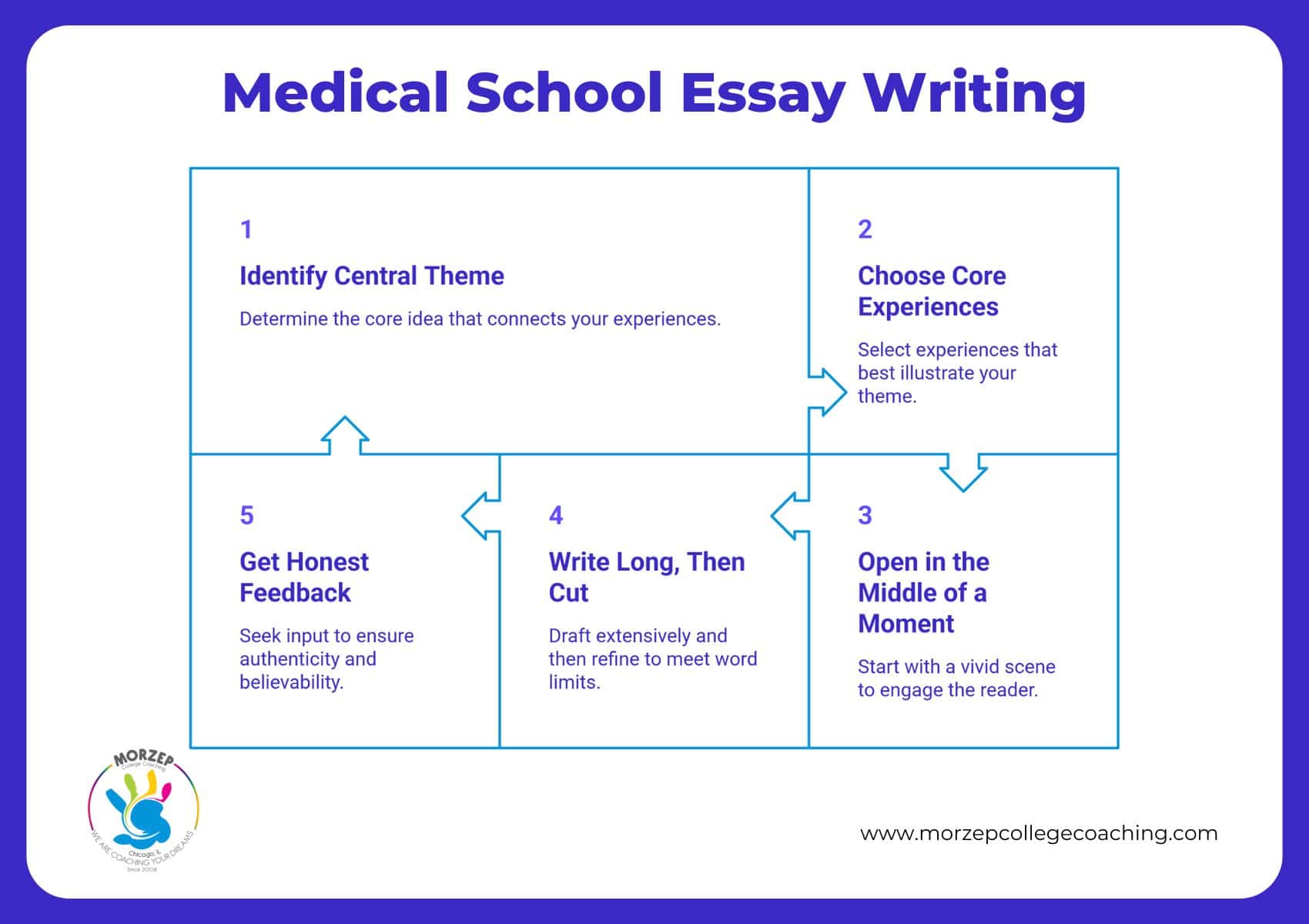
Step 1: Find Your Central Theme
Before you write a single sentence, identify the one idea that ties your path to medicine together. Not a list of qualities. One idea. Everything in your statement should connect back to it.
Step 2: Choose Your 1–2 Core Experiences
You don’t need to write about everything. Pick the experiences that most clearly illustrate your theme and where you have the most genuine reflection to offer. Authenticity matters more than achievement here.
Step 3: Open in the Middle of a Moment
Don’t open with a statement about medicine or your childhood. Drop the reader directly into a specific place, a specific conversation, a specific realization. Let them feel it before you analyze it.
Step 4: Write Long, Then Cut
Write a first draft around 1,000 words without worrying about the limit. Then cut to 650–850 by removing everything that doesn’t serve your central theme. For more on what medical schools look for in strong applicants, make sure your overall application context is solid, too.
Step 5: Get Honest Feedback
You want feedback from someone who can answer: ‘Does this sound like a real person? Do I believe this person genuinely wants to become a doctor? For a closer look at narrative structure, consider reviewing strong essay examples before drafting your own.
If you’re also preparing for what comes after the application, our guide on medical school interview questions can help you build on your personal statement story during the interview.
When should I start writing my personal statement?
Start several months before applications open. A strong personal statement usually takes multiple drafts, feedback, and thoughtful revision.
Working on your application to medical school?
Our coaches work one-on-one with students to develop their personal story, sharpen their essays, and build a strategy for getting into the right school.
Get Help Writing a Personal Statement That Stands Out
Writing a medical school personal statement is one of the most personal things you’ll do in this entire process. Getting it right takes time, honest reflection, and usually a few rounds of feedback from people who know what they’re looking at.
At Morzep College Coaching, we’ve helped students across the U.S. (and beyond) build personal statements that are honest, specific, and memorable. We don’t hand you a template. We work with the story you already have and help you tell it the right way.
We have 60+ years of combined experience, we work in English and Spanish, and we cover everything from early pre-med planning through researching top medical schools to interview prep.
If you’re ready to start, schedule a free consultation, and let’s build your game plan together.