


You’ve wanted this for a long time. Maybe since middle school, maybe longer. The white coat. The rounds. The moment a patient looks at you and trusts you with something they can’t trust to anyone else. Getting into medical school is one of the most demanding journeys in all of higher education. It starts earlier and requires more strategy than most students realize.
The overall acceptance rate for U.S. medical schools sits at around 41% of applicants who apply, but that number is misleading. Many students apply who aren’t truly competitive. Among well-prepared candidates, the picture is clearer: a strong GPA, a competitive MCAT score, meaningful clinical experience, and a compelling application can get you there.
This guide walks through every major piece of the puzzle. If you want expert support through the process, our medical school consulting services at Morzep pair students with coaches who have navigated this system for decades. They will guide you on how to get into medical school. But first, here’s what we’ll cover:
If you’re ready to approach this the right way, let’s get into it.
In This Article
Speak with a college coach today!
Speak with an expert college coach and learn if working with one is right for your academic journey. Free 15-minute consultation, no cost, no obligations.
Academic Requirements and GPA Benchmarks
Medical school admissions committees look at your GPA first. Meeting the academic side of medical school requirements is the foundation on which everything else is built, and the data is clear about what competitive looks like.
What GPA Do You Need?
According to the AAMC, the average GPA for medical school matriculants in 2025-2026 was 3.75 overall, with a science GPA of 3.68. At the most competitive programs, admitted students routinely show GPAs of 3.8 or higher.
That said, a lower GPA doesn’t close the door. A strong upward trend, an outstanding MCAT score, and exceptional clinical experience can offset numbers that fall short of those averages, especially at DO programs and many solid MD schools.
Pre-Med Requirements: The Core Coursework
Nearly every U.S. medical school requires the same core pre-med requirements. Plan to complete at least one year (two semesters) of each:
Biology with lab — foundational for MCAT and medical coursework
General Chemistry with lab — required at virtually every school
Organic Chemistry with lab — yes, all of it
Physics with lab — often the most dreaded, but manageable with early preparation
Biochemistry — now standard at most schools since its addition to the MCAT
Statistics or Math — requirements vary, but most schools expect at least one course
English or Writing — communication matters in medicine
Some programs also recommend or require psychology, sociology, and ethics. Check each school’s requirements individually.
What MCAT score do you need to get into medical school?
Most competitive MD programs look for MCAT scores between 510 and 515, with the average for all matriculants around 511-512. DO programs are typically competitive in the 502-508 range. There is no universal minimum, but scores below 500 present a significant barrier at the majority of U.S. medical schools.
Science GPA vs. Total GPA
AMCAS calculates two separate GPAs: your overall GPA and your science (BCPM) GPA — biology, chemistry, physics, and math. Schools pay close attention to your science GPA because it’s the best predictor of how you’ll perform in your first two years of medical school. A great overall GPA with a weak science GPA is a red flag. Make sure your performance in BCPM courses reflects your best work.
MCAT Score for Medical School: What You Need to Know
The MCAT is the great equalizer in med school admissions. It’s the only standardized measure schools can use to compare every applicant on the same scale, regardless of where they went to undergrad or how grade inflation varied by institution.
What Is a Competitive MCAT Score?
The MCAT is scored from 472 to 528. The average score for all test-takers is around 500-501. But that’s not the bar you’re aiming for.
For competitive MD programs, admitted students typically score between 510 and 515. Top programs like Harvard Medical School and Johns Hopkins often admit students with averages above 520. For DO programs, scores in the 502-508 range are more common among successful applicants.
Something I see students underestimate often: the difference between a 507 and a 514 is not just seven points on a scale. It dramatically changes which schools are realistic targets and how your application reads to an admissions committee.
When Should You Take the MCAT?
Most students take the MCAT in the spring of their junior year, after completing their core prerequisite coursework. That timing allows you to apply in June of that same year (the earliest application window opens) without a gap year.
If you’re not ready, don’t rush it. A retake from a higher baseline is almost always more effective than recovering from a weak first attempt. Take a diagnostic practice test, establish your baseline, and give yourself 3-4 months of dedicated prep before your first official sit.

Photo by www.kaboompics.com on Pexels
How to Study for the MCAT
This isn’t a test you can cram for. The MCAT tests reasoning and application, not memorization alone.
Start with a full-length practice test to diagnose your weaknesses by section
Devote 300-400 hours of prep time for most students who want a competitive score
Use official AAMC materials — they’re the most accurate reflection of the real test
Don’t neglect the CARS section — it’s the hardest to improve quickly and can’t be brute-forced with content review
Take at least 5-6 full-length practice exams under timed, test-day conditions
What is required for medical school admissions?
Medical school requires a bachelor’s degree, pre-med prerequisite courses (biology, chemistry, physics, biochemistry), a competitive MCAT score, direct clinical experience, meaningful extracurriculars, letters of recommendation, and a personal statement submitted through AMCAS, AACOMAS, or TMDSAS, depending on the program type.
Clinical Experience and Extracurriculars
Admissions committees want to know one thing above everything else: does this person actually understand what being a doctor requires? Clinical experience is how you prove it.
How Much Clinical Experience Do You Need?
There’s no official minimum, but most competitive applicants have at least 200-300 hours of direct patient care experience by the time they apply. Exceptional applicants often have 500 hours or more. Types of experience that count:
Medical scribing — one of the best ways to see clinical workflows firsthand
EMT or medical assistant work — high-quality, direct patient contact
Hospital volunteering — valuable, but lower intensity than paid clinical roles
Hospice or nursing home volunteering — underrated and meaningful to committees
Clinical research participation — particularly strong for research-heavy schools
Physician Shadowing
Shadowing is distinct from clinical experience — it’s observation, not hands-on care. But it matters. Plan to shadow at least 40-80 hours across multiple specialties and settings. Shadowing one physician for 10 hours in a single office doesn’t show the breadth committees are looking for.
Try to shadow in both outpatient and inpatient settings. Shadow a primary care physician. Shadow a surgeon. Shadow an ER doctor if you can. Each adds a different dimension to your understanding and your application story.
Research Experience
Research isn’t required at most medical schools, but it’s strongly valued. If you’re targeting research-intensive programs or MD-PhD programs, it’s close to essential. Even a single meaningful research experience, where you understand what you contributed and why it mattered, is far stronger than a resume full of short-term lab placements you can’t speak to.
Extracurricular Activities: Quality Over Quantity
The AMCAS Work and Activities section allows 15 entries, but you don’t need to fill all 15 with impressive-sounding titles. Three or four activities where you showed deep commitment, leadership, and growth are worth more than fifteen surface-level involvements.
Pick activities that mean something to you. Admissions readers can tell the difference between genuine involvement and resume padding.
The Medical School Application Process, Step by Step
The medical school admission process runs on a specific cycle, and the timing matters more than most students expect. Getting into medical school on your first try depends as much on when you submit as on what you submit.
Which Application Service Do You Use?
The three main application services each serve different program types:
AMCAS (American Medical College Application Service) — used by most MD (allopathic) programs in the U.S.
AACOMAS (American Association of Colleges of Osteopathic Medicine Application Service) — used by DO (osteopathic) programs
TMDSAS (Texas Medical and Dental Schools Application Service) — used by Texas public medical schools
Many applicants apply to both MD and DO schools simultaneously. There’s no penalty for that, and it significantly broadens your options.
Primary Applications
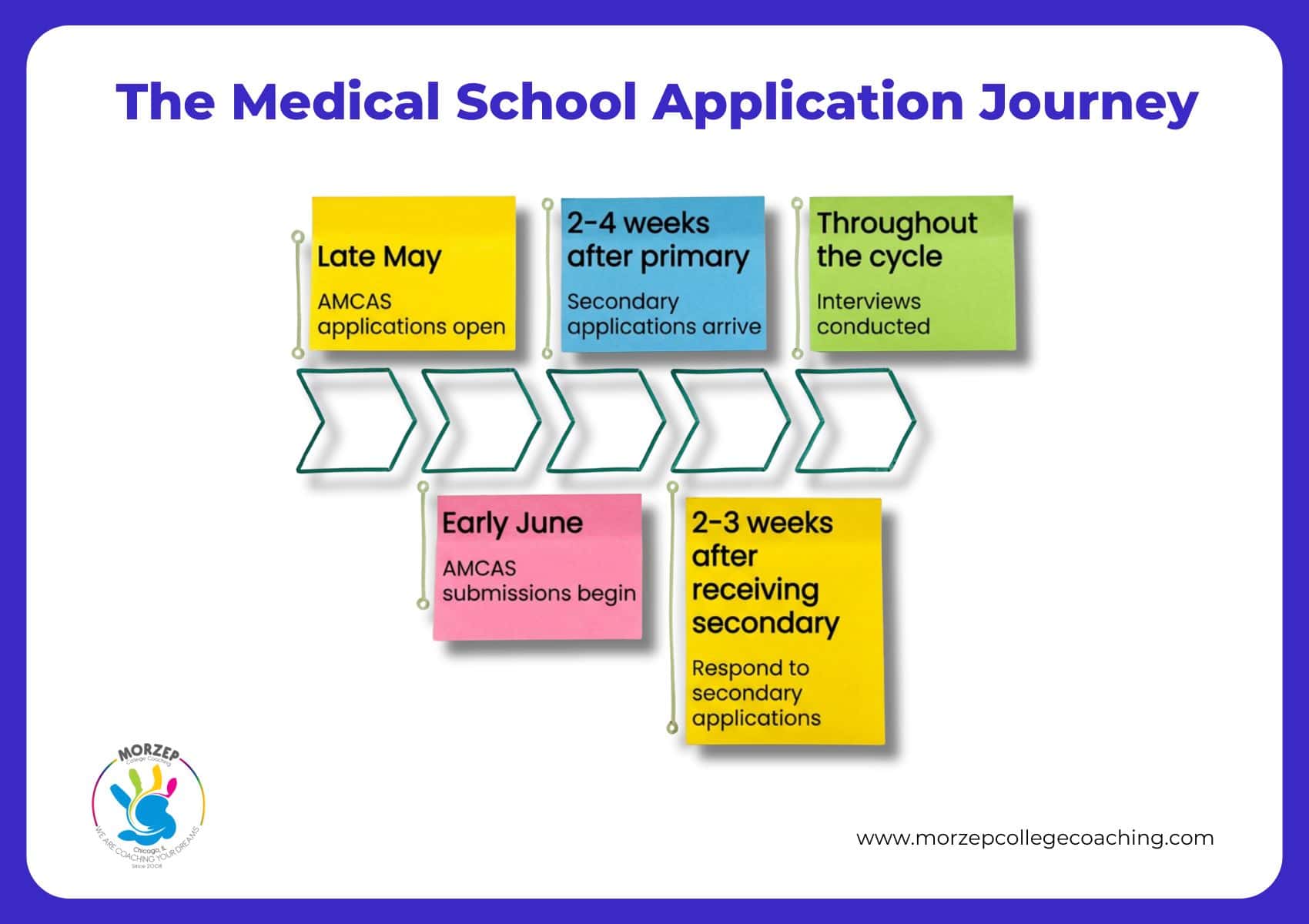
AMCAS applications open in late May and can be submitted starting in early June. The earlier you submit, the better. Medical school admissions is rolling — schools review and interview as applications come in, not all at once after a deadline. Submitting in June vs. September is not a minor difference. It can be the difference between an interview and a waitlist.
Your primary application includes your academic record, MCAT score, Work and Activities section, and personal statement.
Secondary Applications
After submitting your primary, most schools will send secondary applications with additional essay prompts specific to their program. These typically arrive within 2-4 weeks of your primary submission. Respond quickly, ideally within 2-3 weeks of receiving each secondary. Sitting on secondaries costs you interview spots.
Med School Interview Questions and Format
Medical school interviews come in two main formats: traditional one-on-one or panel interviews, and Multiple Mini Interviews (MMI), which use a series of short scenario-based stations. Both are common, and preparation looks different for each.
Practice out loud. Record yourself. Know your application inside out. Committees read your file before the interview, and they will ask you to speak about specific things you wrote. Any inconsistency between what you wrote and what you say will stand out.
Writing a Strong Medical School Personal Statement
Your medical school personal statement is 5,300 characters, roughly one page. In that space, you need to answer one question better than thousands of other applicants: why do you want to be a doctor, and why are you the right person to become one?
What Makes a Strong Personal Statement?
The weakest personal statements describe what medicine is. The strongest ones show what the applicant has already experienced, what it taught them, and why that experience leads directly to medicine as a career, not as a backup, not as a default, but as a calling.
Some things that work:
A specific opening scene — a patient interaction, a moment in the clinic, a conversation with a physician that changed your thinking
Honest reflection — what you didn’t know before vs. what you know now
Forward motion — the statement ends pointing toward your future, not summarizing your past
Some things that don’t:
Opening with a quote (almost always feels impersonal)
Listing experiences that are already in your Work and Activities section
The phrase “ever since I was a child, I wanted to be a doctor”
Passive, distant writing that never lets the reader meet you
How Many Drafts Should You Write?
More than you think. Most successful applicants write 5-8 complete drafts of their personal statement. Start early — April or May of your application year at the latest. The first draft is for getting your thoughts out. The fifth draft is the one that might actually work.
Is a 3.7 GPA too low for medical school?
A 3.7 GPA is competitive at many medical schools, though it falls slightly below the national average for MD matriculants (3.75). Combined with a strong MCAT score, typically 511 or above, a 3.7 GPA can still support a successful application, particularly at DO programs and many solid allopathic schools.
Letters of Recommendation
Strong letters of recommendation come from people who know you well, not from the most impressive names you can find. A letter from a Nobel laureate who met you twice in a large lecture hall is worth far less than a letter from a professor who watched you grow across two years of coursework.
Who Should Write Your Letters?
AMCAS requires at least three letters for most schools: typically two from science faculty and one from a non-science faculty member or physician. Many schools have their own additional requirements. Check each school’s specific policies.
Ideal letter writers for medical school applications include:
Science professors whose courses you excelled in (especially if you did lab research with them)
Physicians you shadowed or worked with, especially if the relationship was substantive and extended
Research mentors who can speak specifically to your curiosity, work ethic, and contributions
Non-science faculty who can speak to your writing, critical thinking, and character
When to Ask
Ask early. Request letters at least 3-4 months before your submission deadline. Give your letter writers your personal statement, your CV, and a brief note reminding them of specific things you worked on together. The easier you make it for them to write a detailed, personalized letter, the better that letter will be.

Photo by www.kaboompics.com on Pexels
How to Choose the Right Medical Schools
Applying to medical school is expensive and time-consuming. Being strategic about where you apply matters as much as the quality of your application.
Building Your School List
Most successful applicants apply to 15-25 schools, divided across three categories:
Reach schools — your stats fall slightly below their averages, but your application has distinctive strengths
Target schools — your GPA and MCAT align well with their average accepted applicant profile
Safety schools — your stats are comfortably above their averages
Use the AAMC’s MSAR (Medical School Admissions Requirements) tool to compare your numbers against each school’s published GPA and MCAT ranges for admitted students. It’s one of the most useful resources available to applicants and is worth the subscription cost.
In-State vs. Out-of-State
Public medical schools heavily favor in-state applicants. If your state has a public medical school, it belongs on your list. Out-of-state acceptance rates at public schools can be dramatically lower, sometimes under 5%, even for applicants with strong stats.
MD vs. DO Programs
DO programs (osteopathic medicine) are legitimate, fully accredited pathways to becoming a physician. DO graduates can practice in any specialty and can match into competitive residency programs. For applicants with GPAs in the 3.2-3.5 range or MCAT scores in the mid-to-high 500s, DO programs significantly expand your options without compromising your career goals.
Your Medical School Timeline
Getting into medical school is not a sprint. It’s a four-year plan that starts the day you begin undergraduate coursework.
How Hard Is It to Get Into Medical School?
Harder than most students expect. but more achievable than it looks from the outside. The AAMC reports that roughly 22,000 students matriculate into U.S. medical schools each year out of around 55,000 applicants. That’s about a 40% overall acceptance rate. But among students with above-average GPAs and MCAT scores who apply strategically, acceptance rates are considerably better. The difficulty isn’t impossibility; it’s the length and precision of the preparation required.
Freshman Year
The steps to becoming a doctor begin here. Start your prerequisite coursework strong. Get A’s in your science classes from the start; an upward GPA trend is good, but a strong foundation is better. Start thinking about what extracurricular activities actually interest you, not what looks good on paper.
Sophomore Year
Continue prerequisites. Start seeking clinical experience. Hospital volunteering, scribe positions, and research opportunities are all appropriate to pursue now. Identify 2-3 faculty members whose courses you’re excelling in — these are future letter writers.
Junior Year
This is the most important year. Take the MCAT in the spring (April or May) after completing your prerequisites. Begin drafting your personal statement in April. Request letters of recommendation in April or May. Submit your AMCAS application as early in June as possible.
Senior Year and Beyond
Complete secondary applications quickly after receiving them. Prepare for interviews. Some students receive decisions as early as October. Others hear back in the spring. If you don’t get in on your first cycle, this is not the end. A gap year with purposeful additions to your application is a legitimate and often successful path.
The Students Who Get In Start Here
One thing we hear often from families: they wish they’d started planning earlier. The students who tend to navigate this process with the least stress are the ones who start thinking about it in ninth and tenth grade, not junior year of college. That head start doesn’t mean burning out early. It means knowing what’s coming and having time to build toward it intentionally.
Guiding students into medical school is some of the most rewarding work we do at Morzep College Coaching. With more than 60 years of combined experience in higher education, our coaches understand exactly what it takes — from freshman year GPA management to MCAT prep strategy to AMCAS application timing.
We don’t follow a template. We build a personalized plan around your student’s strengths, goals, and timeline. Whether your student is in middle school and starting to dream about medicine, or a college junior getting ready to apply, we’re here to make the path clear and the process manageable. Reach out today to schedule a free consultation, and let’s figure out the best next step together.