


You’ve spent years building your medical school application. The GPA, the MCAT, the clinical hours, the personal statement. And then, the invitation arrives. You have a medical school interview.
Now the pressure shifts. Everything that got you this far was on paper. The interview is where the real you shows up, and where a lot of med school applicants stumble, not because they aren’t qualified, but because they haven’t prepared the right way.
Knowing the most common medical school interview questions is a start. Knowing how to answer them authentically and what different interview formats demand is what separates the candidates who get accepted from the ones who wonder what went wrong.
If you want a coaching team to work through your answers with you and help you with your medical school admissions, schedule a free consultation with Morzep College Coaching.
In This Article
Speak with a college coach today!
Speak with an expert college coach and learn if working with one is right for your academic journey. Free 15-minute consultation, no cost, no obligations.
Why the Medical School Interview Is Make-or-Break
Being invited to an interview means your application has already cleared the first filter. According to the AAMC, only about 15–18% of primary applicants to any given medical school receive an interview invitation. The admissions committee already believes you can handle the academic demands of medical education. The interview answers a different question: Do we want this person in our program, our hospital, and eventually our profession?
At Morzep College Coaching, our coaches have seen students with near-perfect stats get waitlisted because they came across as rehearsed, and students with less competitive numbers get accepted because they showed genuine insight and self-awareness. The interview is coachable. Preparation isn’t about memorizing answers; it’s about knowing yourself well enough to speak clearly under pressure.
Preparing for medical school interviews? Our coaches at Morzep College Coaching have 60+ years of combined experience helping students prepare for every interview format. Schedule a free consultation today.
How long do medical school interviews last?
Traditional one-on-one interviews run 30–60 minutes. Panel interviews can run up to 90 minutes. MMI circuits typically last 2–3 hours total, with individual stations lasting 6–8 minutes each.
Interview Formats: Traditional vs. MMI
Medical schools use two primary interview structures, and traditional and MMI interview questions require very different preparation strategies.
Traditional Medical School Interview
The traditional interview is a one-on-one or panel conversation with faculty, physicians, or admissions staff, typically running 30–60 minutes. Most are either open-file (the interviewer has read your application) or closed-file (they haven’t). The preparation here focuses on your narrative — connecting your experiences, motivations, and values into answers that feel genuine, not scripted. Every question is an opportunity to show the interviewer who you are beyond your application.
Multiple Mini Interview (MMI) Format
The multiple mini interview is a circuit-style format where students rotate through 6–10 stations, each lasting 6–8 minutes, scored by a different evaluator. Each station presents a scenario, ethical dilemma, or task. MMI questions test communication, empathy, ethical reasoning, and critical thinking, not your personal story. Schools like Duke, UCSD, the University of Cincinnati, and many Canadian medical schools use the MMI format.
The key insight for MMI prep: the goal isn’t to reach the “right answer.” Evaluators are watching how you think through a problem. Students who reason carefully through complexity score higher than those who rush to a conclusion.
What is the difference between a traditional and MMI medical school interview?
A traditional medical school interview is a 30–60 minute conversation about your background, motivations, and goals. An MMI is a circuit of 6–10 timed stations where each presents a new scenario or ethical dilemma scored by a different evaluator, assessing how you think and communicate, not just what you say.
Most Common Medical School Interview Questions
Across hundreds of med school interviews, certain questions appear at nearly every school. Every medical school candidate should have a practiced, genuine answer to each, built from reflection, not memorization.
“Tell Me About Yourself”
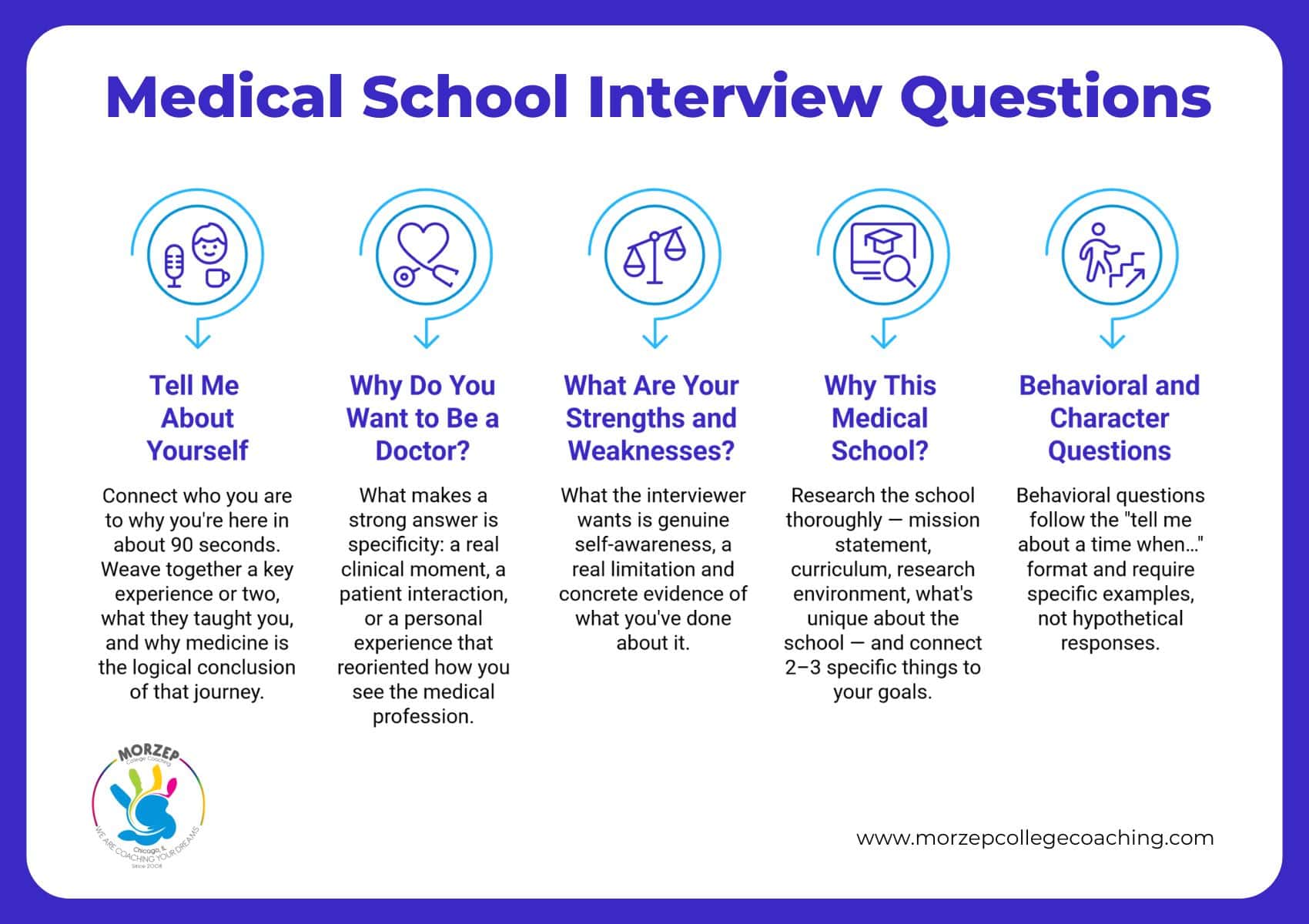
This is almost always the first question, and the one most med school applicants answer badly by reciting their résumé. A strong answer connects who you are to why you’re here in about 90 seconds. Weave together a key experience or two, what they taught you, and why medicine is the logical conclusion of that journey.
Sample answer: “Growing up, I watched my grandmother navigate a chronic illness without anyone in our family who understood the medical system. That experience made me pay close attention to the physicians who made her feel like a person, not a case. I went on to volunteer at a federally qualified health center and complete a research fellowship studying health disparities. Every step reinforced the same goal: I want to be the kind of physician who closes gaps in knowledge, in access, and in care.”
“Why Do You Want to Be a Doctor?”
This is the most important question in the interview. “I want to help people” is not a sufficient answer — every nurse, social worker, and teacher wants to help people. What makes a strong answer is specificity: a real clinical moment, a patient interaction, or a personal experience that reoriented how you see the medical profession. The more concrete and personal your reason for pursuing a career in medicine, the more it will resonate.
“What Are Your Strengths and Weaknesses?”
Don’t say your weakness is “working too hard.” What the interviewer wants is genuine self-awareness, a real limitation and concrete evidence of what you’ve done about it. That quality of honest self-reflection is one of the most important traits a physician can have.
“Why This Medical School?”
Research the school thoroughly — mission statement, curriculum, research environment, what’s unique about the school — and connect 2–3 specific things to your goals. Generic enthusiasm signals low preparation. The interviewer wants to know you’ve thought seriously about what makes this the right fit for where you want to go.
Behavioral and Character Questions
Behavioral questions follow the “tell me about a time when…” format and require specific examples, not hypothetical responses. Common behavioral interview questions for medical school include:
“Tell me about a time you failed.“ — Show what you learned. The failure matters less than the reflection and how it changed your approach.
“How do you handle stress?“ — Be specific. Describe your actual systems, not vague platitudes.
“Describe a time you worked with a difficult team member.” — They’re probing for conflict resolution and interpersonal maturity.
“What would you do if you didn’t get into medical school this year?” — Schools want students who are driven but not fragile. Show growth, not desperation.
When do medical school interview invitations go out?
Most schools send invitations starting in September, with some beginning as early as August. Interviews run through May. Many schools use rolling admissions, so being invited to an interview early in the cycle is an advantage.
Healthcare Knowledge and Medical Ethics Questions
Interviewers want to know you’re entering the medical profession with open eyes, not an idealized version of it. Be prepared to discuss current medical challenges: the physician shortage, burnout (the AMA reports over 50% of physicians show signs of it), medical technology and telemedicine, healthcare access and equity, and questions about diversity in the physician workforce.
Principles of Medical Ethics
Ethics questions appear in both traditional interviews and MMI stations. They present a dilemma without a clean answer intentionally. The four principles of medical ethics you need to be fluent with are:
Autonomy — A patient’s right to make decisions about their own care
Beneficence — Acting in the patient’s best interest
Non-maleficence — Avoiding harm
Justice — Fair distribution of healthcare resources
Sample ethical questions: “A patient refuses a life-saving transfusion for religious reasons — what do you do?” or “You discover a colleague is impaired at work — how do you respond?” There is rarely one correct answer. What matters is that you can identify the competing values, acknowledge the tension, and reason to a defensible position. That ability is at the core of what medical students develop throughout their training.

Photo by Tima Miroshnichenko on Pexels
MMI Interview Questions and How to Approach Them
A typical MMI station gives you a written prompt outside the door, two minutes to read it, then 6–8 minutes to respond to an evaluator who does not guide you. The evaluator scores communication, empathy, critical thinking, and ethical reasoning, not whether you reached the “right” conclusion.
Common types of MMI stations and sample questions:
Ethical scenario: “A friend asks you to prescribe antibiotics they believe they need. What do you do?”
Policy/opinion: “Should medical schools give admissions preference to applicants from underserved communities?”
Role-play: Delivering bad news to a patient, or de-escalating a conflict
Personal reflection: “Describe a time you had to change your mind about something important.”
The biggest MMI mistake: rushing to a conclusion. Before entering any station, ask yourself three questions: Who is affected? What values are in tension? What would a reasonable, compassionate physician do? That 10-second reset transforms a panicked reaction into a structured response.
How to Prepare for a Medical School Interview
Start 4–6 weeks out. Here’s the core preparation framework:
Know your application cold. Every experience you listed is fair game. Read your personal statement and secondary essays as if you’re the interviewer, and be ready to discuss any of it fluently.
Research each school thoroughly. Go beyond the school website — understand the mission, curriculum format, research environment, and what’s unique about the school before you arrive. This sharpens every answer, not just “Why this school?”
Build a question bank and practice answering out loud. Write foundational answers to the 20 most common interview questions, then say them out loud repeatedly. Reading an answer and saying it are completely different. Aim for fluency, not memorization. Practice answering from any angle, so follow-up questions don’t throw you.
Do mock interviews. Practice with someone who will give you honest feedback. Record yourself — filler words, rushed pacing, flat affect, and lack of eye contact are all fixable before the actual interview, but only if you identify them. For MMI prep, simulate timed stations so the format feels familiar.
Prepare questions to ask. Every interview ends with “Do you have any questions for us?” Strong questions to ask your interviewer include how the school supports students through the preclinical-to-clinical transition, what opportunities exist in your specific area of interest, and how the curriculum prepares students for residency. Avoid anything answered on the school website.
What are the most common medical school interview questions?
The most common questions include “Tell me about yourself,” “Why do you want to be a doctor,” “What are your strengths and weaknesses,” “Why this school,” and behavioral questions about failure, teamwork, and resilience. Every medical school candidate should have a practiced, genuine answer to each of these.
Medical School Interview Tips
A few things that consistently separate strong med school candidates from exceptional ones:
Every question is an opportunity. The interviewer wants to see who you are. Approach every question as a chance to show something meaningful, not just to avoid saying something wrong.
Be specific. Vague answers signal shallow preparation. Concrete examples and real moments signal lived experience. The interviewer wants to know you, not your archetype.
Don’t over-script. Memorized answers collapse under follow-up questions. Know your stories deeply enough to tell them from any starting point. That’s the difference between memorization and fluency.
Show intellectual humility. You don’t need to know everything about medical ethics or healthcare policy. Demonstrating curiosity and honesty about the limits of your knowledge is more impressive than a polished non-answer.
Bring warmth. Medicine is a relationship-based profession. Interviewers are looking for someone medical students would want as a colleague and patients would trust as a doctor. Competence impresses. Warmth connects.
What to Expect on Interview Day
Interview day is a full day — campus tour, lunch with current medical students, information sessions, and the actual interview. All of it is observed. Arrive 15–20 minutes early, dress business professional, and silence your phone from the moment you walk in. The informal conversations at lunch and in the hallways are part of the evaluation.
Throughout the interview process, maintain eye contact, keep your body language open, and if a question genuinely surprises you, take a breath and say so — “Let me think through that” is a sign of someone who takes questions seriously, not someone who doesn’t have an answer. After the med school interview day, send a brief thank-you email within 24–48 hours. Few applicants do. The ones who do are remembered.
Build Confidence for Your Medical School Interview with Morzep College Coaching
We’ve coached students through every medical school interview format — traditional, MMI, panel, open-file, and closed-file. The preparation gap is almost never about knowledge. It’s about self-awareness, story clarity, and the ability to communicate under pressure. Those are skills. And skills are coachable.
At Morzep College Coaching, we work one-on-one with students to develop their “why medicine” story, drill common med school interview questions and sample answers, run full mock interviews with detailed feedback, and prepare the questions to ask that signal genuine interest in the school.
We work in English and Spanish, with 60+ years of combined experience in U.S., Canadian, European, and Mexican admissions. If you have an interview coming up, reach out to schedule a free consultation. Let’s build your game plan together.