


If you’re a parent wondering whether your child is already behind, take a breath. That worry is normal, and it’s almost always bigger than the reality. The truth is, there’s no single “right” moment to start preparing for college.
What matters is knowing the next best step for whatever grade your student is in right now.
This guide lays out a clear, grade-by-grade roadmap so you can find your child’s stage, see what to do next, and trade anxiety for a plan. So when to start preparing for college?
Speak with a college coach today!
Speak with an expert college coach and learn if working with one is right for your academic journey. Free 15-minute consultation, no cost, no obligations.
When Should You Start Thinking About College?
Meaningful college prep can begin as early as middle school, but every year of high school offers a valuable next step. Earlier, low-pressure exposure builds confidence and keeps options open. And no matter when you begin, it’s never too late to strengthen your student’s application.
Think of this less as a race and more as a series of small, well-timed moves. Early years are about habits and exploration. Later years are about testing, essays, and applications to each college or university on the list.
The point of thinking about college early isn’t to pile on pressure. It’s the opposite. When you can see the whole timeline laid out, each year feels manageable instead of overwhelming.
Below, find your student’s grade and the handful of things worth focusing on now.
How Early to Prepare for College: Middle School (8th Grade)
Eighth grade isn’t about applications. It’s about exploration and building the habits that make everything later feel easier. And one decision here matters more than most parents realize: course selection, especially math placement.
The math track your student starts on often determines whether advanced courses like calculus are reachable by senior year. According to U.S. News, students who take Algebra 1 in eighth grade and qualify for geometry in ninth grade are on track to reach calculus before graduating. This is a foundation-setting phase, not a countdown. Here’s where to put your energy:
Plan a rigorous-but-realistic 9th-grade course path. Talk with the school counselor about math placement and honors options that keep future doors open.
Build study and organization habits. A simple planner, a consistent homework routine, and knowing how to ask for help go a long way.
Explore extracurricular interests lightly. Let your student sample a club, a sport, or a volunteer activity to see what genuinely excites them.
That’s it for middle school. Get these right, and your student walks into high school with real momentum.
When should my 16-year-old start applying for college?
A 16-year-old is typically a junior, which is exactly when college prep intensifies, though actual applications happen in the fall of senior year. Use junior year to test, build a college list, and research aid, so that when applications open in senior fall, your student is ready to move.
What Grade to Start College Prep: Freshman Year (9th Grade)
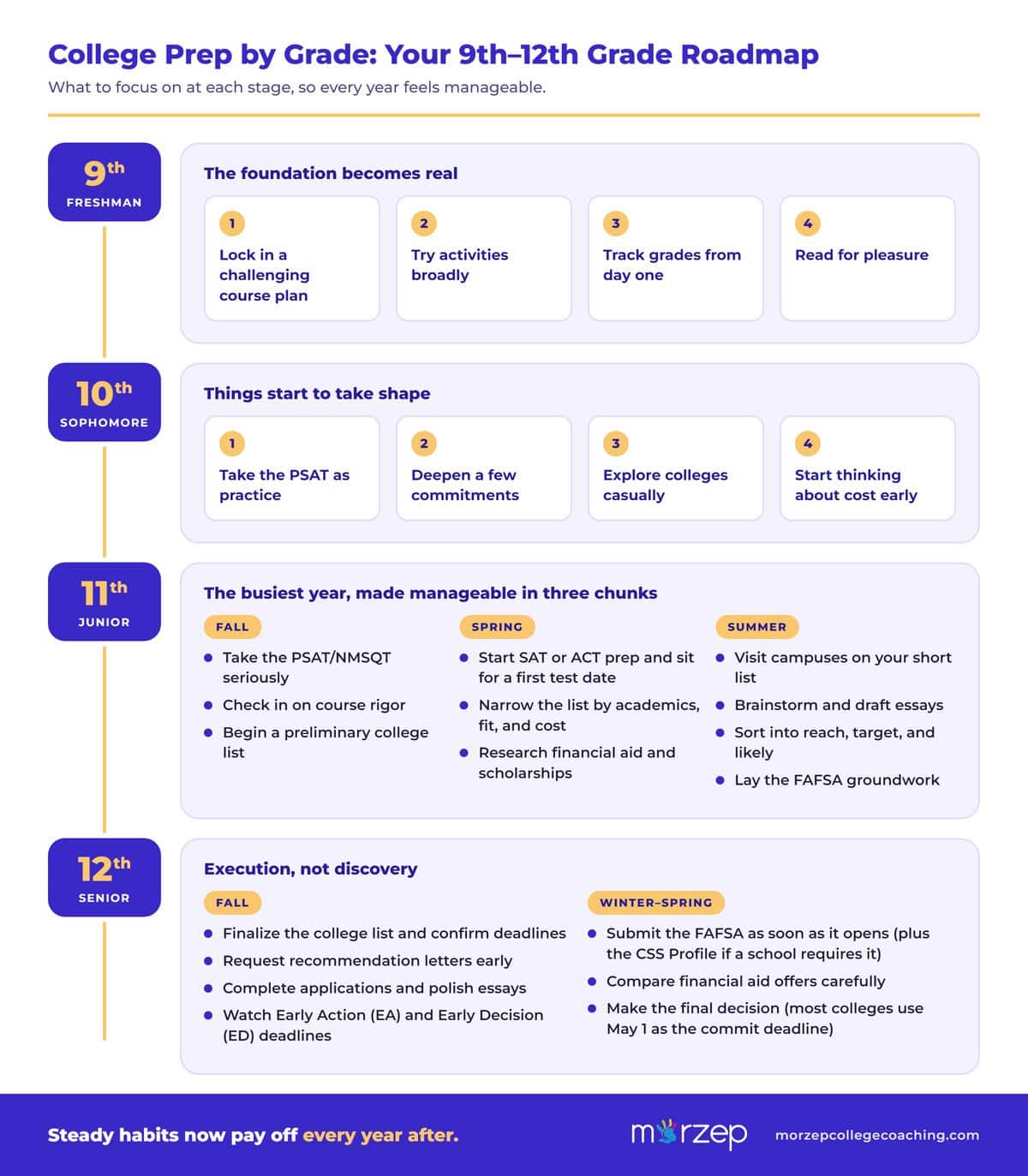
Freshman year is when the foundation becomes real. The goal is settling into a course plan that keeps the AP and honors trajectory open, while exploring extracurricular activities broadly. Colleges want to see depth develop over time, not a fully formed resume at 14.
One thing many families overlook: freshman-year grades count toward the cumulative GPA that colleges see. That’s not a reason to panic. It’s just a reason to start strong.
Lock in a challenging course plan. Choose classes that stretch your student without overwhelming them, keeping honors and AP options alive for later years.
Try activities broadly. Encourage your student to explore a few clubs, sports, or interests rather than committing narrowly this early.
Track grades from day one. Since freshman grades factor into the cumulative GPA, help your student stay on top of coursework and build good study rhythms.
Read for pleasure. Regular reading quietly strengthens the reading and writing skills that later show up on standardized tests.
Ninth grade is about laying track, not sprinting. Steady habits now pay off every year after.
Sophomore Year (10th Grade) College Prep Checklist
Sophomore year is where things start to take shape without the pressure of senior-year deadlines. This is the ideal time for low-stakes standardized test familiarity and for deepening the activities your student actually cares about.
Many students take the PSAT (Preliminary SAT) in the fall of their sophomore or junior year as a diagnostic. According to The Princeton Review, most students take it in the fall of their sophomore or junior year, and a sophomore PSAT is purely practice, useful feedback with no stakes attached.
Take the PSAT as practice. Treat it as a diagnostic to see where your student stands, not a high-stakes exam.
Deepen a few commitments. Encourage your student to go deeper in one or two activities, look for leadership roles, and consider a summer internship or job.
Explore colleges casually. Drop by a nearby campus, browse schools online, and try a career-interest inventory to start understanding fit.
Start thinking about cost early. Begin talking as a family about budget and financial aid so nothing feels sudden two years from now.
Understanding fit and cost now, rather than late, gives your family room to make thoughtful choices instead of rushed one
Junior Year (11th Grade): The Most Critical Year to Prepare for College
Junior year has a reputation for being the busiest, and honestly, it earns it. But here’s the good news: breaking it into fall, spring, and summer chunks makes it entirely manageable. You don’t have to do everything at once.
Fall of Junior Year
This is when standardized testing gets real. The junior-year PSAT/NMSQT is the qualifying test for the National Merit Scholarship Program. As the National Merit Scholarship Corporation explains, students planning the usual four years of high school must take it in their junior year to enter the competition.
Take the PSAT/NMSQT seriously this fall, since only the junior-year score counts for National Merit.
Check in on course rigor with your counselor to confirm your student’s schedule reflects their strongest effort.
Begin a preliminary college list with counselor input, keeping it broad for now.
Spring of Junior Year
Spring shifts toward the SAT or ACT and toward money. This is the season to research financial aid and scholarship criteria before the senior-year application crunch arrives.
Start SAT or ACT test prep and sit for a first official test date.
Narrow the college list based on academics, fit, and cost.
Research financial aid and scholarship requirements now, so nothing surprises you next fall.
Summer Before Senior Year
Summer is a gift. With no classes competing for attention, your student can get ahead on the pieces that make senior fall feel calm. This is also when it pays to understand the full college application process from start to finish, so nothing catches you off guard in the fall.
Visit campuses on your student’s short list to confirm what feels right.
Brainstorm and draft college essays while there’s time to revise.
Sort the list into reach, target, and likely tiers.
Lay the groundwork for the FAFSA (Free Application for Federal Student Aid) by creating FSA IDs and gathering documents.
Do the summer work, and senior year becomes about finishing strong instead of scrambling.
Is 27 a good age to start college?
Absolutely. There’s no expiration date on higher education, and non-traditional and returning students bring maturity and focus that strengthen their applications. The grade-by-grade timeline here is built for high schoolers, but the core principles (plan your courses, prep for tests, file the FAFSA) apply just as well to adult learners.
Senior Year (12th Grade): Finalizing Your College Application Timeline
Senior year is execution, not discovery. If the earlier stages were followed, twelfth grade is simply about finishing what you started. Here’s how the college application timeline breaks down.
Fall of Senior Year
Finalize the college list and confirm each school’s deadlines.
Request recommendation letters early, giving teachers plenty of lead time.
Complete applications and polish essays. If your student is staring at a blank page, our breakdown of the most common college essay prompts and how to answer them makes drafting far less daunting.
Watch Early Action (EA) and Early Decision (ED) deadlines closely. ED is binding, while EA lets your student compare offers before committing.
Winter-Spring of Senior Year
This is the financial home stretch. The FAFSA is the gateway to federal aid, and it’s required by law to open on or before October 1 each year for the following academic year. Filing early matters because some state and college aid runs out.
Submit the FAFSA as soon as it’s available, and complete the CSS Profile (a separate financial aid application many private colleges require) if any of your student’s colleges request it for their own institutional aid.
Compare financial aid offers carefully, weighing grants and scholarships against loans.
Make the final decision. Most colleges use May 1, traditionally known as National College Decision Day, as the deadline for accepted students to commit.
Cross the finish line, celebrate, and know your student put their best self forward.
College Prep by Grade: What If You’re Starting Late?
Maybe you found this guide during your student’s junior or senior year, and that ideal middle-school head start is long gone. Here’s the reassurance you came for: a later start doesn’t mean lost opportunity. It just means a more focused plan.
You’re not “behind.” You simply start from where you are. Here’s the quick triage:
Just starting in 10th grade? You’re in great shape. Focus on course rigor, one or two meaningful activities, and treating the PSAT as practice.
Just starting in 11th grade? Prioritize the SAT or ACT, build a college list with your counselor, and begin researching financial aid this spring.
Just starting in 12th grade? Move straight to essentials: finalize a realistic list, request recommendations, meet application and early deadlines, and file the FAFSA promptly.
Whatever the grade, the answer is never “you missed it.” It’s always “here’s your next best step.”
Is a 2.7 GPA bad for college admissions?
A 2.7 GPA is one factor among many, not a verdict. Colleges review applications holistically, weighing course rigor, essays, activities, recommendations, and growth over time. Plenty of colleges welcome students in this range, and an upward trend, a strong essay, or standout activities can meaningfully help your student stand out.
Start Your College Plan With Morzep
Whatever grade your student is in right now, there’s a clear, achievable next step. That’s the whole idea behind how we coach: we build a personalized plan around your student’s exact stage, not a checklist meant for every family.
We know the concerns you’re carrying. Want a transparent timeline and regular check-ins? We’ll give you that structure and accountability. If the essays, test prep, and college selection feel overwhelming, we’ll break them into manageable steps and coach your student through each one. And if cost and return on investment are top of mind, we’ll help you sort through financial aid and position your student to stand out as a scholarship applicant.
Not sure where to begin? It helps to know how to choose the right college admissions consultant before you commit. As the college admissions consultants at Morzep, we’re goal-oriented coaches who nurture the skills your scholar already has. We don’t treat a problem; we conquer goals.
Schedule a free consultation with Morzep today to build a personalized college prep timeline for your student.